




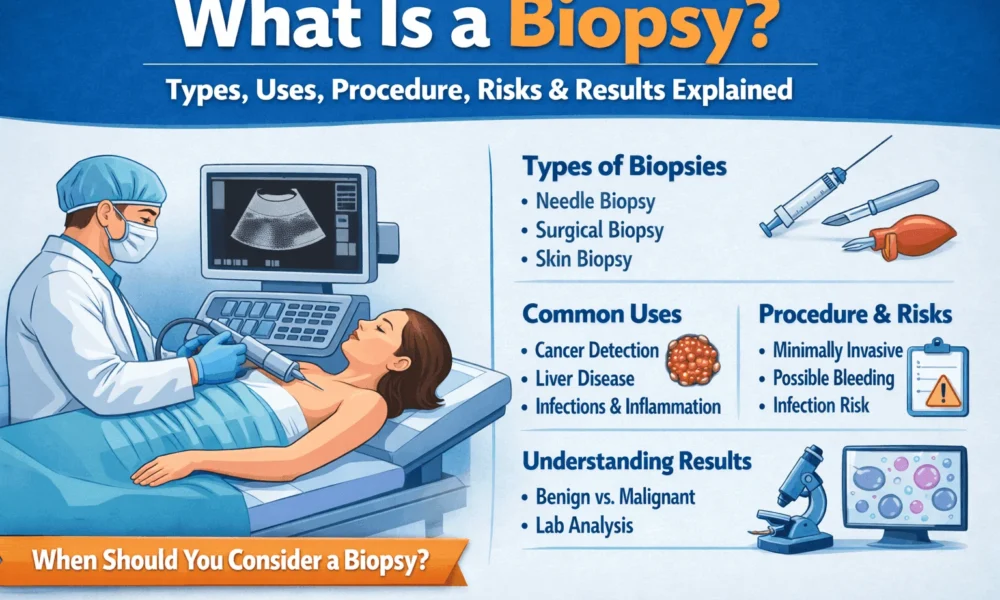

What Is a Biopsy? Types, Uses, Procedure, Risks & Results Explained
Learn what a biopsy is, why it is done, the different biopsy types, how it works, possible risks, recovery, and how biopsy results are used to diagnose disease.
What Is a Biopsy?
A biopsy is one of the most important medical tests used to diagnose cancer, infections, inflammation, and many other health conditions. If your doctor finds a suspicious lump, abnormal scan result, skin lesion, or unexplained symptom, a biopsy may be the next step to find out exactly what is going on.
In simple terms, a biopsy is a procedure in which a small sample of tissue or cells is removed from the body and examined in a laboratory.
Although the word “biopsy” can sound frightening, the procedure is often quick, safe, and extremely valuable in helping doctors make an accurate diagnosis and choose the right treatment.
In this complete guide, you’ll learn what a biopsy is, why it is done, the different types of biopsy, how the procedure works, the possible risks, recovery process, and what biopsy results actually mean.
Quick Answer: What Is a Biopsy?
A biopsy is a medical test that removes a sample of tissue or cells from the body so it can be examined under a microscope or tested in a lab.
Doctors use biopsies to:
- Confirm or rule out cancer
- Identify infections
- Diagnose inflammation
- Evaluate organ disease
- Understand the cause of abnormal lumps or symptoms
Why Is a Biopsy Done?
A biopsy helps doctors look beyond symptoms and scans to understand what is happening at the cellular level.
While tests like:
- X-rays
- Ultrasounds
- CT scans
- MRI scans
…can show that something abnormal is present, they usually cannot confirm exactly what it is.
That’s where a biopsy becomes essential.
A biopsy may help doctors:
- Determine whether a lump is benign or cancerous
- Confirm a suspected tumor
- Diagnose inflammatory conditions
- Identify the cause of infection
- Assess damage in organs such as the liver, kidney, or bone marrow
- Check if a disease is worsening or responding to treatment
For many cancers, a biopsy is the only way to make a definite diagnosis.
What Does a Biopsy Detect?
A biopsy is commonly used to investigate possible cancer, but it is also used for many non-cancerous conditions.
Conditions a Biopsy Can Help Diagnose
1) Cancer
Biopsies are often done when a person has:
- A lump
- Swelling
- A suspicious growth
- Abnormal imaging results
The tissue sample helps determine whether the cells are:
- Benign (non-cancerous)
- Malignant (cancerous)
2) Infections
A biopsy can help identify:
- Whether an infection is present
- What type of organism may be causing it
3) Inflammatory Diseases
Doctors may use biopsy results to better understand inflammation in tissues or organs.
4) Liver Disease
A liver biopsy can help evaluate:
- Cirrhosis
- Liver fibrosis
- Hepatitis
- Tumors or cancer
- Treatment response
5) Digestive and Intestinal Conditions
Biopsies may be used to diagnose:
- Peptic ulcer disease
- Celiac disease
- Malabsorption disorders
- Intestinal inflammation
6) Blood and Bone Marrow Disorders
Bone marrow biopsies can help diagnose:
- Leukemia
- Lymphoma
- Multiple myeloma
- Anemia and other blood abnormalities
7) Organ Transplant Monitoring
Doctors may also perform biopsies to check:
- Whether the body is rejecting a transplanted organ
- Whether the original disease has returned
How Does a Biopsy Work?
The way a biopsy is performed depends on:
- Which body part needs testing
- How deep the tissue is
- Whether the area can be felt from the outside
- Whether imaging guidance is needed
In many cases, a doctor uses a needle to remove a small tissue sample. In other cases, a surgical procedure may be needed.
General Biopsy Process
Most biopsies follow these basic steps:
1) Locate the abnormal area
Doctors may identify the suspicious area through:
- Physical exam
- Imaging scans
- Endoscopy
2) Numb or prepare the area
Depending on the biopsy type, you may receive:
- Local anesthesia
- Sedation
- General anesthesia
3) Remove the tissue sample
The doctor takes a sample using:
- A needle
- A cutting tool
- A scope
- Surgery
4) Send the sample to a lab
A pathologist examines the tissue under a microscope and may also run special tests.
5) Review the results
The biopsy results help determine whether the tissue is:
- Normal
- Inflamed
- Infected
- Precancerous
- Cancerous
Types of Biopsy
There are many different types of biopsy procedures. The best one depends on the body area and the medical concern.
1) Needle Biopsy
A needle biopsy is one of the most common and least invasive biopsy methods.
A doctor inserts a needle through the skin into the suspicious area to remove cells or tissue.
Common uses:
- Breast lumps
- Enlarged lymph nodes
- Thyroid nodules
- Liver lesions
- Lung lesions
- Prostate abnormalities
Needle biopsies often allow patients to go home the same day.
2) Fine Needle Aspiration (FNA)
Fine needle aspiration biopsy uses a very thin hollow needle attached to a syringe.
It is used to remove:
- Fluid
- Small cell samples
- Tissue fragments
Best for:
- Cysts
- Thyroid nodules
- Lymph nodes
- Soft tissue lumps
Benefits:
- Quick
- Minimally invasive
- Often done in a clinic
3) Core Needle Biopsy
A core needle biopsy uses a larger needle than FNA and removes a small cylinder (core) of tissue.
This allows doctors to preserve more tissue structure for analysis.
Common uses:
- Breast biopsy
- Prostate biopsy
- Liver biopsy
- Soft tissue masses
Why it matters:
Core biopsies often provide more detailed information than fine needle aspiration.
4) Vacuum-Assisted Biopsy
A vacuum-assisted biopsy uses a suction device to pull tissue into the needle, allowing the doctor to collect multiple or larger tissue samples through one insertion point.
Common uses:
- Breast lesions
- Deeper tissue abnormalities
Benefits:
- Larger sample collection
- Fewer needle insertions
- Improved diagnostic accuracy in some cases
5) Image-Guided Biopsy
Some abnormalities are too deep or too small to feel through the skin. In these cases, doctors use imaging guidance to place the biopsy needle accurately.
Imaging methods may include:
- Ultrasound
- X-ray
- CT scan
- MRI
- Fluoroscopy
Common uses:
- Lung biopsy
- Liver biopsy
- Kidney biopsy
- Prostate biopsy
- Deep breast lesions
This helps the doctor target the exact suspicious area with greater precision.
6) Skin Biopsy
A skin biopsy removes a sample of skin tissue to diagnose skin conditions, infections, or skin cancer.
Common skin biopsy types include:
Shave Biopsy
A thin layer of skin is shaved off using a sharp blade.
Punch Biopsy
A circular tool removes a deeper sample of skin.
Incisional Skin Biopsy
A small part of the suspicious area is removed.
Excisional Skin Biopsy
The entire lesion or suspicious growth is removed.
Common uses:
- Suspicious moles
- Skin cancer
- Rashes
- Chronic skin diseases
- Inflammatory skin conditions
7) Excisional Biopsy
In an excisional biopsy, the doctor removes the entire suspicious lump, lesion, or abnormal area.
This is commonly done when:
- The lump is small
- The lesion is easy to remove
- The doctor wants both diagnosis and removal at the same time
Common uses:
- Skin lesions
- Small breast lumps
- Lymph nodes
- Surface tumors
8) Incisional Biopsy
An incisional biopsy removes only part of the abnormal tissue, not the whole area.
Doctors may use this when:
- The lesion is large
- Full removal is not practical initially
- A diagnosis is needed before major surgery
9) Endoscopic Biopsy
An endoscopic biopsy uses a thin, flexible tube with a camera and light called an endoscope.
The doctor inserts the scope into the body to view internal organs and collect tissue samples.
Common examples include:
- Colonoscopy biopsy – from the colon
- Bronchoscopy biopsy – from the lungs or airways
- Cystoscopy biopsy – from the bladder
- Upper GI endoscopy biopsy – from the esophagus, stomach, or small intestine
Common uses:
- GI bleeding
- Polyps
- Lung lesions
- Ulcers
- Suspicious internal growths
10) Laparoscopic Biopsy
A laparoscopic biopsy is often used to collect tissue from inside the abdomen.
A doctor inserts a thin tube with a camera through a small incision to locate the abnormal area and remove tissue.
Common uses:
- Abdominal masses
- Liver lesions
- Ovarian abnormalities
- Internal tumors
11) Bone Marrow Aspiration and Bone Marrow Biopsy
A bone marrow biopsy is used to examine the tissue inside the bones where blood cells are produced.
Doctors often perform:
- Bone marrow aspiration (liquid sample)
- Bone marrow biopsy (solid tissue sample)
…at the same time.
Common uses:
- Leukemia
- Lymphoma
- Multiple myeloma
- Unexplained anemia
- Abnormal blood counts
Common biopsy site:
- Back of the hip bone (pelvis)
12) Surgical Biopsy
A surgical biopsy is used when a suspicious area cannot be reached safely with a needle or scope, or when previous biopsy results were inconclusive.
A surgeon makes an incision to access and remove tissue.
Common uses:
- Deep tumors
- Lymph nodes
- Breast masses
- Hard-to-reach abnormalities
A surgical biopsy may be:
- Incisional – removes part of the abnormal area
- Excisional – removes the entire abnormal area
13) Liquid Biopsy
A liquid biopsy is a newer type of test that uses a blood sample instead of tissue to look for cancer-related material, such as tumor DNA.
Possible uses:
- Monitoring cancer treatment
- Tracking tumor changes
- Detecting certain cancer markers
Important note:
Liquid biopsy is promising, but it does not replace standard tissue biopsy in many situations.
What Happens During a Biopsy?
The exact experience depends on the type of biopsy, but many people want to know what the procedure actually feels like.
Before the Biopsy
You may be asked to:
- Sign a consent form
- Change into a gown
- Stop eating or drinking for a few hours (for some procedures)
- Pause blood thinners if instructed by your doctor
- Arrange a ride home if sedation is used
During the Biopsy
You may:
- Lie on your back, stomach, or side
- Sit upright depending on the biopsy location
- Need to stay still or hold your breath briefly
Pain control may include:
- Local anesthesia – numbs the area
- Sedation – helps you relax
- General anesthesia – used for some surgical procedures
What it may feel like:
- Pressure
- Mild pinching
- Brief stinging from numbing medicine
- Soreness afterward
Many biopsy procedures are not very painful, especially when local anesthesia is used.
Is a Biopsy Painful?
This is one of the most common concerns.
In most cases:
A biopsy causes mild discomfort rather than severe pain.
The level of discomfort depends on:
- The biopsy type
- The body area
- Whether anesthesia is used
- Your pain sensitivity
Afterward, you may feel:
- Soreness
- Tenderness
- Mild bruising
- Temporary swelling
Most discomfort improves within a short time.
Risks of a Biopsy
Biopsies are generally considered safe, but like all medical procedures, they do carry some risk.
Possible Biopsy Risks Include:
1) Bleeding
Minor bleeding is common, but heavier bleeding is less common.
2) Infection
Any time the skin is broken, there is a small risk of infection.
3) Pain or Soreness
Some tenderness at the biopsy site is expected.
4) Bruising or Swelling
This may happen after needle or skin biopsies.
5) Injury to Nearby Structures
Rarely, a biopsy near important organs may accidentally affect nearby tissue.
Examples may include:
- Lung biopsy affecting lung tissue
- Abdominal biopsy affecting nearby organs
6) Scarring
Some biopsies, especially skin or surgical biopsies, may leave a small scar.
Serious complications are uncommon, and your doctor will explain any specific risks related to your procedure.
Benefits of a Biopsy
Despite the worry it can cause, a biopsy is often one of the most useful steps in getting the right diagnosis.
Main Benefits of a Biopsy:
- Helps confirm or rule out cancer
- Identifies the exact disease process
- Helps choose the right treatment
- May prevent unnecessary treatment
- Can reveal how aggressive a disease may be
- Often less invasive than exploratory surgery
How to Prepare for a Biopsy
Preparation depends on the type of biopsy you are having.
General Biopsy Preparation Tips
Before your procedure, ask your doctor:
- Can I eat or drink beforehand?
- Should I take my regular medications?
- Do I need to stop blood thinners or aspirin?
- Will I need someone to drive me home?
- Will I need stitches or dressing care afterward?
Also tell your doctor if you:
- Have allergies
- Are pregnant
- Take supplements
- Have bleeding problems
- Have had anesthesia issues in the past
Recovery After a Biopsy
Recovery time varies depending on how invasive the biopsy was.
Recovery may look like this:
After minor biopsies:
- You may go home the same day
- Resume normal activities quickly
- Have only mild soreness
After more invasive biopsies:
- You may need a few hours of observation
- Activity restrictions may apply
- You may need wound care or follow-up instructions
After the biopsy, contact your doctor if you have:
- Fever
- Severe pain
- Heavy bleeding
- Redness or pus
- Swelling that worsens
- Difficulty breathing (after certain biopsies)
Biopsy Analysis and Results
After the tissue is removed, it is sent to a laboratory and examined by a pathologist.
The sample may be:
- Processed chemically
- Frozen
- Thinly sliced
- Stained
- Examined under a microscope
What the Pathologist Looks For
The pathologist checks whether the tissue is:
- Normal
- Inflamed
- Infected
- Precancerous
- Cancerous
If cancer is present, the report may also help determine:
- The type of cancer
- The grade of the cancer
- How aggressive it appears
- Sometimes where the cancer originated
Cancer grade explained:
Cancer cells are often graded based on how abnormal they look under the microscope.
In general:
- Low-grade cancers tend to grow more slowly
- High-grade cancers may be more aggressive
This information helps guide treatment planning.
How Long Do Biopsy Results Take?
One of the most stressful parts of the process is waiting for results.
Typical biopsy result timeline:
- Simple results: 2 to 3 days
- More detailed analysis: 7 to 10 days
- Complex or special testing: Sometimes longer
In some surgical settings, a pathologist may examine tissue during the operation and provide a rapid preliminary result.
Always ask your doctor:
- When results will be ready
- How you will receive them
- Who will explain them to you
What Do Biopsy Results Mean?
Biopsy results generally fall into a few categories:
1) Benign
This means the tissue is not cancerous.
2) Malignant
This means cancer is present.
3) Precancerous or Abnormal
This means the cells are not normal and may need treatment or monitoring.
4) Inconclusive
Sometimes the sample does not provide a clear answer, and another biopsy or additional testing may be needed.
Questions to Ask Your Doctor Before a Biopsy
It is completely reasonable to ask questions before the procedure.
Helpful questions include:
- Why do you recommend this biopsy?
- What are you trying to diagnose?
- What type of biopsy will I have?
- Who will perform it?
- Will it be painful?
- Will I need local or general anesthesia?
- How long will it take?
- What are the risks?
- Will I need stitches?
- Will I need someone to drive me home?
- How should I prepare?
- How do I care for the biopsy site afterward?
- When will I get the results?
- What happens if the biopsy is abnormal?
Frequently Asked Questions (FAQ)
1) What is a biopsy in simple words?
A biopsy is a test where a doctor removes a small sample of tissue or cells from the body to check for disease.
2) Does a biopsy mean cancer?
No. A biopsy does not automatically mean cancer. It is used to investigate many conditions, including infections, inflammation, and benign growths.
3) Is a biopsy painful?
Most biopsies cause only mild discomfort, especially when local anesthesia is used.
4) How long does it take to get biopsy results?
Results are often available in 2 to 10 days, depending on the type of testing needed.
5) What is the most common type of biopsy?
Needle biopsy is one of the most common biopsy methods.
6) Can a biopsy remove the whole lump?
Yes. In an excisional biopsy, the entire suspicious lump or lesion may be removed.
7) What happens if a biopsy is positive?
If the biopsy shows cancer or another abnormal condition, your doctor will explain the findings and discuss the next steps, which may include more tests or treatment.
Final Thoughts
A biopsy is one of the most valuable tools in modern medicine because it helps doctors move from suspicion to certainty.
Whether it is used to investigate a lump, confirm cancer, diagnose inflammation, or evaluate an organ problem, a biopsy provides critical information that imaging alone often cannot.
Although waiting for results can be stressful, the procedure itself is often straightforward, safe, and essential for choosing the right treatment.
If your doctor recommends a biopsy, asking the right questions and understanding the process can help you feel more informed and more prepared.
Resource Links

Other Articles

