



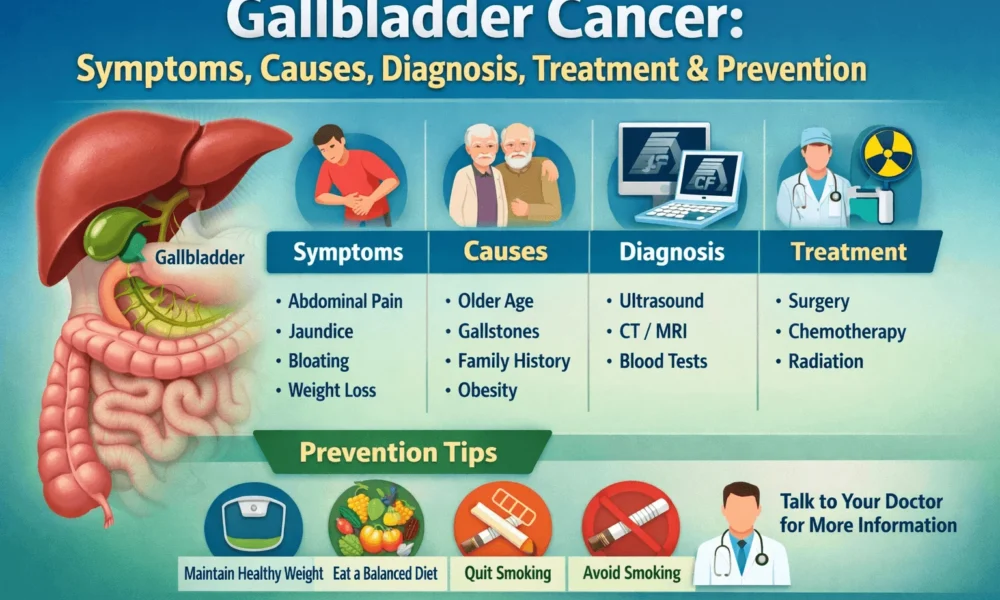
Gall Bladder Cancer – Symptoms, Causes, Diagnosis, Treatment & Prevention

Gallbladder Cancer: Symptoms, Causes, Diagnosis, Treatment & Prevention
Learn about gallbladder cancer symptoms, causes, stages, diagnosis, treatment options, and prevention tips. A complete patient-friendly guide.
Gallbladder cancer is a rare but serious type of cancer that starts in the gallbladder — a small, pear-shaped organ located beneath the liver. Although uncommon, it can be dangerous because it often develops silently and may not cause symptoms until it reaches an advanced stage.
The gallbladder stores bile, a digestive fluid produced by the liver that helps break down fats. When cancer forms in the gallbladder, it can interfere with bile flow, digestion, and nearby organs such as the liver and bile ducts.
In this guide, you’ll learn what gallbladder cancer is, early warning signs, causes, risk factors, diagnosis, treatment options, stages, and prevention tips — all in a clear, reader-friendly format optimized for both users and search engines.
What Is Gallbladder Cancer?
Gallbladder cancer is a disease in which abnormal cells grow uncontrollably in the tissues of the gallbladder. These cells may form a tumor and can eventually spread to nearby tissues, lymph nodes, the liver, or distant organs if not treated.
This cancer is considered rare, but it can be aggressive because it is often hard to detect early. Many people are diagnosed only after the disease has already spread beyond the gallbladder.
Quick Answer:
Gallbladder cancer is a rare cancer that begins in the gallbladder and often causes symptoms only in later stages.
Where Is the Gallbladder Located?
The gallbladder is a small pouch found on the upper right side of the abdomen, just below the liver.
Its main functions include:
- Storing bile made by the liver
- Releasing bile into the small intestine
- Helping digest fats after meals
Because the gallbladder is hidden deep inside the abdomen, tumors may grow unnoticed for a long time.
Symptoms of Gallbladder Cancer
Gallbladder cancer often causes no symptoms in the early stages. When symptoms do appear, they can be mistaken for more common gallbladder or digestive problems such as gallstones, indigestion, or infection.
Common symptoms of gallbladder cancer include:
- Pain in the upper right abdomen
This is one of the most common symptoms. The pain may feel:
- Dull and aching
- Sharp if the bile duct becomes blocked
- Persistent or worsening over time
- Jaundice
Jaundice happens when bile cannot flow properly.
Signs of jaundice:
- Yellowing of the skin
- Yellowing of the whites of the eyes
- Dark urine
- Pale or clay-colored stools
- Itchy skin
- Abdominal bloating or swelling
Some people notice a swollen or full feeling in the stomach area.
- Nausea and vomiting
This may happen due to blocked bile flow or pressure from the tumor.
- Loss of appetite
You may feel full quickly or lose interest in eating.
- Unexplained weight loss
Unexpected weight loss can be a warning sign of many cancers, including gallbladder cancer.
- Fever
Some people develop fever if there is associated inflammation or infection.
- Enlarged gallbladder
A doctor may detect a swollen gallbladder during an exam or imaging test.
Important: These symptoms do not always mean cancer, but they should never be ignored — especially if they last more than a few days.
Causes of Gallbladder Cancer
The exact cause of gallbladder cancer is not fully known. However, doctors know that it begins when healthy gallbladder cells develop DNA mutations.
These mutations cause cells to:
- Grow too quickly
- Avoid normal cell death
- Form a tumor
- Spread into nearby tissues
Over time, the cancer may invade:
- The liver
- Bile ducts
- Lymph nodes
- Nearby digestive organs
Risk Factors
Certain conditions and lifestyle factors can increase the likelihood of developing gallbladder cancer.
Major risk factors include:
- Gallstones
Gallstones are the most common risk factor. They can cause long-term irritation and inflammation in the gallbladder.
However, most people with gallstones do not develop gallbladder cancer.
- Chronic gallbladder inflammation (cholecystitis)
Repeated inflammation can increase the risk of abnormal cell changes.
- Gallbladder polyps
Polyps are small growths inside the gallbladder. Some larger polyps may carry a higher cancer risk.
- Porcelain gallbladder
This rare condition causes calcium deposits to build up in the gallbladder wall and is associated with increased cancer risk.
- Older age
Gallbladder cancer is more common in:
- Adults over 65
- Especially those over 75
- Female sex
Women are more likely than men to develop gallbladder cancer.
- Obesity
Being overweight may increase the risk due to hormonal and metabolic changes.
- Smoking
Smoking may increase the risk of many cancers, including cancers of the biliary system.
- Family history
A close relative with gallbladder cancer may slightly raise your risk.
- Abnormal bile ducts
Some people are born with structural abnormalities in the bile ducts that may increase cancer risk.
Types of Gallbladder Cancer
There are several types of gallbladder cancer depending on which cells the cancer starts in.
- Adenocarcinoma
This is the most common type, making up more than 85% of cases.
It begins in the glandular cells lining the gallbladder.
Subtypes include:
- Non-papillary adenocarcinoma
- Papillary adenocarcinoma
- Mucinous adenocarcinoma
- Squamous Cell Carcinoma
Starts in the squamous-like cells lining the gallbladder.
- Adenosquamous Carcinoma
Contains both glandular and squamous cancer cells.
- Small Cell Carcinoma
A rare and more aggressive type.
- Sarcoma
Starts in the connective tissues of the gallbladder.
- Neuroendocrine Tumors
Rare tumors that begin in hormone-producing cells.
- Lymphoma or Melanoma
These are extremely rare in the gallbladder.
Stages of Gallbladder Cancer
Staging helps doctors understand how far the cancer has spread and guides treatment planning.
Stage I
Cancer is limited to the inner layers of the gallbladder.
Stage II
Cancer has spread to the outer layer of the gallbladder.
Stage III
Cancer has spread to nearby organs such as:
- Liver
- Stomach
- Small intestine
- Nearby lymph nodes
Stage IV
Cancer has spread to distant organs or multiple areas of the body.
Earlier-stage gallbladder cancer has a much better chance of successful treatment.
How Gallbladder Cancer Is Diagnosed
Because symptoms often appear late, doctors usually rely on a combination of blood tests, scans, and procedures to diagnose gallbladder cancer.
- Physical exam and medical history
Your doctor may ask about:
- Pain
- Jaundice
- Weight loss
- Digestive symptoms
- Family history
- Blood tests
Blood tests can help assess:
- Liver function
- Bile flow
- Signs of obstruction or inflammation
- Ultrasound
This is often the first imaging test used to check the gallbladder and nearby organs.
- CT scan
A CT scan can help show:
- Tumor size
- Spread to nearby tissues
- Lymph node involvement
- MRI
MRI gives more detailed images of the gallbladder, liver, and bile ducts.
- ERCP (Endoscopic Retrograde Cholangiopancreatography)
This test uses a flexible tube and dye to look for:
- Blockages
- Narrowing
- Bile duct abnormalities
- Biopsy
A biopsy involves removing a tissue sample to confirm whether cancer cells are present.
- Laparoscopy
A minimally invasive surgery may be used to see whether the cancer has spread inside the abdomen.
Treatment Options
Gallbladder cancer treatment depends on:
- The stage of cancer
- Whether it has spread
- Your overall health
- Tumor location and type
Surgery
-
Cholecystectomy
This is surgery to remove the gallbladder and may be curative in early-stage cases.
-
Extended surgery
If cancer has spread nearby, doctors may also remove:
- Part of the liver
- Nearby bile ducts
- Lymph nodes
Surgery is usually the best chance for cure if the cancer is found early.
Chemotherapy
Chemotherapy uses drugs to kill cancer cells or slow their growth.
It may be used:
- After surgery
- Before surgery in some cases
- For advanced or metastatic gallbladder cancer
Radiation Therapy
Radiation uses high-energy beams to destroy cancer cells.
It may help:
- Shrink tumors
- Reduce pain
- Lower the risk of recurrence after surgery
Targeted Therapy and Clinical Trials
Some patients may benefit from:
- Targeted therapies
- Immunotherapy
- Clinical trials testing newer treatments
These options are more likely to be considered in advanced or difficult-to-treat cases.
Palliative and Supportive Care
If the cancer cannot be cured, treatment may focus on improving quality of life.
This may include:
- Pain relief
- Nutrition support
- Managing jaundice
- Bile duct drainage procedures
- Emotional support
Can Gallbladder Cancer Be Cured?
The best chance for a cure is when gallbladder cancer is found early and removed surgically.
Unfortunately, many cases are diagnosed later because:
- Symptoms are vague
- The gallbladder is hidden deep in the abdomen
- Early tumors often cause no pain
In general:
- Early-stage gallbladder cancer may be curable
- Advanced-stage gallbladder cancer is harder to cure
- Treatment can still help control symptoms and improve survival
Complications
Gallbladder cancer can cause several serious complications, including:
- Blocked bile ducts
- Jaundice
- Infection
- Digestive problems
- Spread to the liver
- Weight loss and malnutrition
- Pain
- Liver dysfunction
How to Reduce the Risk
There is no guaranteed way to prevent gallbladder cancer, but you can lower your risk by improving overall gallbladder and metabolic health.
Prevention tips:
- Maintain a healthy weight
- Eat a balanced, fiber-rich diet
- Avoid smoking
- Stay physically active
- Get treatment for gallstones or chronic gallbladder problems
- Follow up on gallbladder polyps if recommended by your doctor
When to See a Doctor
You should seek medical advice if you have:
- Persistent pain in the upper right abdomen
- Yellow skin or eyes
- Dark urine or pale stools
- Unexplained weight loss
- Nausea that doesn’t improve
- Ongoing bloating or digestive discomfort
Early evaluation matters.
Even if it turns out not to be cancer, these symptoms may still signal another condition that needs treatment.
FAQs
-
What is the first sign of gallbladder cancer?
One of the earliest noticeable symptoms may be pain in the upper right abdomen, though many people have no symptoms early on.
-
Can gallbladder cancer be cured?
Yes, early-stage gallbladder cancer may be cured with surgery. Advanced cases are more difficult to cure.
-
Is gallbladder cancer painful?
It can be. Many people experience abdominal pain, especially if the tumor blocks bile flow or spreads to nearby organs.
-
Does jaundice always mean gallbladder cancer?
No. Jaundice can also be caused by:
- Gallstones
- Hepatitis
- Liver disease
- Bile duct blockage from other causes
-
Who is most at risk for gallbladder cancer?
Risk is higher in:
- Older adults
- Women
- People with gallstones
- Smokers
- Those with chronic gallbladder disease
-
How is gallbladder cancer diagnosed?
Doctors may use:
- Blood tests
- Ultrasound
- CT scan
- MRI
- ERCP
- Biopsy
-
What is the most common type of gallbladder cancer?
Adenocarcinoma is the most common type.
-
Can gallstones cause gallbladder cancer?
Gallstones are a major risk factor, but most people with gallstones never develop cancer.
Conclusion
Gallbladder cancer is rare, but it should never be ignored — especially if you have persistent abdominal pain, jaundice, or unexplained digestive symptoms. Because it often develops without obvious early warning signs, timely diagnosis can make a major difference.
Understanding the symptoms, causes, diagnosis process, and treatment options can help you seek care earlier and make more informed health decisions.
If you or someone you know is experiencing symptoms that may point to a gallbladder problem, speak with a qualified healthcare professional as soon as possible.
Resource Links

Other Articles

About Facial Tics Treatment
Female Groin Body Odor