



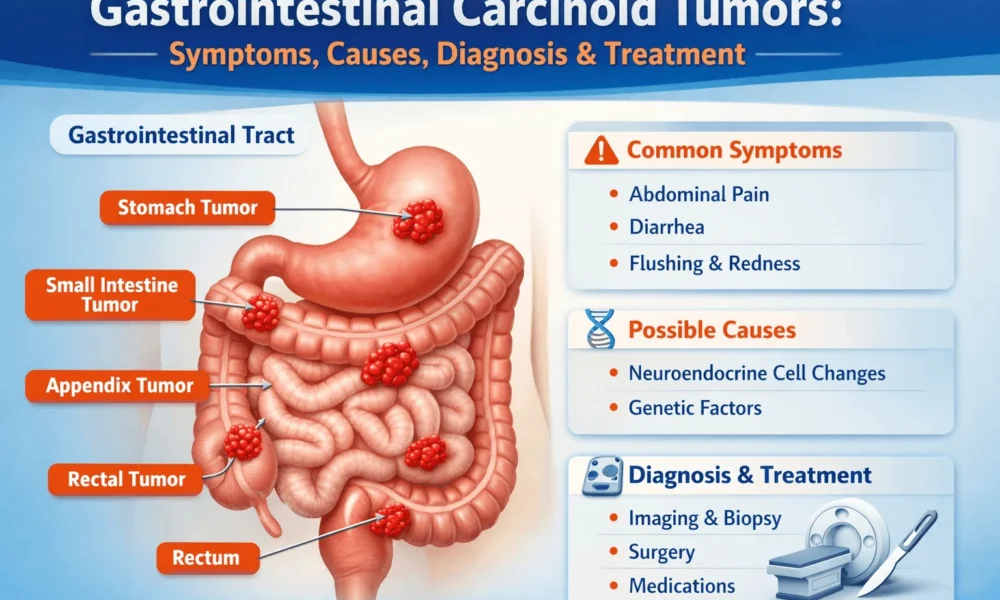
Gastrointestinal Carcinoid Tumors – Symptoms, Causes, Diagnosis & Treatment

Gastrointestinal Carcinoid Tumors: Symptoms, Causes, Diagnosis & Treatment
Learn about gastrointestinal carcinoid tumors, including symptoms, causes, diagnosis, treatment options, complications, and prognosis in this complete patient-friendly guide.
Gastrointestinal carcinoid tumors are a type of slow-growing neuroendocrine tumor (NET) that usually develops in the digestive system. These tumors most often begin in specialized neuroendocrine cells found in the appendix, small intestine, rectum, stomach, or colon.
Although the word “tumor” can sound alarming, gastrointestinal carcinoid tumors often grow more slowly than many other cancers. In some cases, they may not cause symptoms for years and are discovered accidentally during surgery, imaging, or tests for another condition.
Still, these tumors can become serious—especially if they spread, block the bowel, or release hormones that trigger carcinoid syndrome.
In this complete guide, you’ll learn what gastrointestinal carcinoid tumors are, symptoms to watch for, possible causes, diagnosis, treatment options, complications, and what patients should know about prognosis and care.
Quick Answer: What Are Gastrointestinal Carcinoid Tumors?
Gastrointestinal carcinoid tumors are slow-growing neuroendocrine tumors that start in hormone-producing cells of the digestive tract.
They are most commonly found in the:
- Appendix
- Small intestine
- Rectum
- Stomach
- Colon
These tumors may:
- Grow slowly over time
- Release hormones such as serotonin
- Cause symptoms like abdominal pain, diarrhea, flushing, or bowel blockage
- Spread to the liver or other organs in advanced cases
What Is the Gastrointestinal Tract?
The gastrointestinal (GI) tract is the part of the body that:
- Digests food
- Absorbs nutrients and water
- Moves waste through the intestines
- Eliminates waste from the body
It includes:
- Stomach
- Small intestine
- Large intestine (colon)
- Rectum
- Appendix
The lining of the GI tract contains neuroendocrine cells, which act like a mix of:
- Nerve cells
- Hormone-producing cells
These cells help regulate:
- Digestive juices
- Intestinal movement
- Hormone release
When these cells grow abnormally, they can form carcinoid tumors.
What Is a Carcinoid Tumor?
A carcinoid tumor is a type of neuroendocrine tumor (NET) that develops from neuroendocrine cells.
These tumors can occur in several parts of the body, but they most commonly begin in:
- The digestive tract
- The lungs
When they occur in the digestive system, they are called gastrointestinal carcinoid tumors.
Important to know:
Not all carcinoid tumors behave the same way.
Each tumor may differ in:
- Growth speed
- Hormone production
- Size
- Location
- Risk of spread
- Response to treatment
That’s why individual diagnosis and treatment planning are so important.
Where Do Gastrointestinal Carcinoid Tumors Usually Start?
Gastrointestinal carcinoid tumors can form in different parts of the digestive tract, but they most commonly begin in the:
Most common GI carcinoid tumor locations:
- Appendix
- Small intestine
- Rectum
They may also occur in:
- Stomach
- Colon
In some people, multiple tumors may develop at the same time.
Are Gastrointestinal Carcinoid Tumors Cancer?
Yes, gastrointestinal carcinoid tumors are generally considered a type of cancer, but they are often slow-growing and may behave differently from more aggressive cancers.
Some remain localized for years, while others may:
- Spread to nearby tissues
- Travel to the liver
- Release hormones into the bloodstream
- Cause serious complications
Because of this, they should always be evaluated and managed carefully.
Symptoms of Gastrointestinal Carcinoid Tumors
One of the biggest challenges with GI carcinoid tumors is that they often do not cause symptoms early on.
Many people discover them:
- During surgery for appendicitis
- During a colonoscopy
- During scans for another condition
- After symptoms develop later
When symptoms do occur, they usually depend on:
- The tumor’s location
- Its size
- Whether it is causing a blockage
- Whether it is producing hormones
Common Symptoms of Gastrointestinal Carcinoid Tumors
1) Abdominal Pain
A tumor in the intestines or appendix may cause:
- Cramping
- Pressure
- Ongoing stomach discomfort
- Pain after eating
2) Diarrhea
Frequent or unexplained diarrhea can happen, especially if the tumor releases hormone-like substances.
3) Nausea and Vomiting
These symptoms may occur if the tumor causes irritation or a partial bowel obstruction.
4) Bowel Obstruction
Some tumors can block part of the intestine, leading to:
- Severe abdominal pain
- Bloating
- Vomiting
- Inability to pass stool or gas
This may become a medical emergency.
5) Rectal Bleeding
A tumor in the rectum or lower bowel may cause:
- Blood in stool
- Rectal bleeding
- Unexplained anemia
6) Rectal Pain
Rectal carcinoid tumors may cause discomfort or pressure.
7) Skin Flushing
Some patients experience sudden:
- Redness of the face
- Warmth in the face or neck
- Flushing episodes
This may be a sign of carcinoid syndrome.
What Is Carcinoid Syndrome?
Carcinoid syndrome happens when a carcinoid tumor releases hormones and chemicals—especially serotonin—into the bloodstream.
This usually happens when the tumor has spread, often to the liver, allowing these substances to bypass the body’s normal filtering process.
Symptoms of carcinoid syndrome may include:
- Facial flushing
- Chronic diarrhea
- Wheezing
- Rapid heartbeat
- Abdominal cramping
Not all GI carcinoid tumors cause carcinoid syndrome, but when it occurs, it can strongly affect quality of life and may require medication.
Causes of Gastrointestinal Carcinoid Tumors
The exact cause of gastrointestinal carcinoid tumors is not fully understood.
Like many cancers, they likely begin when mutations occur in the DNA of neuroendocrine cells.
These changes can cause the cells to:
- Keep growing
- Avoid normal cell death
- Form a tumor
- Possibly invade nearby tissue or spread to other organs
What doctors do know:
These tumors begin in neuroendocrine cells, which are found throughout the digestive tract and help regulate digestion and hormone release.
Risk Factors for GI Carcinoid Tumors
Certain factors may increase the risk of developing gastrointestinal carcinoid tumors.
1) Older Age
These tumors are more often diagnosed in older adults.
2) Family History
Some inherited conditions can raise the risk, especially:
Multiple Endocrine Neoplasia Type 1 (MEN1)
People with MEN1 may develop tumors in hormone-producing glands, including neuroendocrine tumors.
3) Sex
Some neuroendocrine tumors are diagnosed slightly more often in women, though risk can vary depending on tumor location.
4) Genetic and Molecular Factors
Research continues to explore how specific tumor genes and molecular changes influence growth and treatment response.
How Are Gastrointestinal Carcinoid Tumors Diagnosed?
Diagnosing GI carcinoid tumors often requires a combination of:
- Medical history
- Imaging
- Lab tests
- Endoscopy
- Biopsy
Because symptoms can be vague, diagnosis may take time—especially in people with small, slow-growing tumors.
Tests Used to Diagnose GI Carcinoid Tumors
1) Blood Tests
Blood tests may detect:
- Hormones released by the tumor
- Substances linked to neuroendocrine activity
2) Urine Tests
Doctors may check for breakdown products of hormones such as serotonin in the urine.
3) Imaging Tests
Imaging helps find the tumor’s:
- Location
- Size
- Spread
Common imaging tests include:
- CT scan
- MRI
- PET scan
- Octreotide scan
- X-ray
4) Endoscopy or Scope Procedures
Doctors may use a camera-based procedure to look inside the digestive tract.
Examples include:
- Upper endoscopy – examines the esophagus, stomach, and upper small intestine
- Colonoscopy – checks the colon and rectum
- Capsule endoscopy – a pill-sized camera used to examine the small intestine
5) Biopsy
A biopsy is usually needed to confirm the diagnosis.
During a biopsy, a doctor removes a tissue sample using:
- A needle
- Endoscopy
- Surgery
The tissue is then tested in a lab to confirm:
- Whether it is a carcinoid tumor
- What type of neuroendocrine tumor it is
- How aggressive it appears
How Serious Are Gastrointestinal Carcinoid Tumors?
The seriousness depends on:
- Tumor location
- Tumor size
- Hormone activity
- Whether it has spread
- Whether it is causing blockage or organ complications
Some tumors are found early and treated successfully.
Others may be more complex, especially if they:
- Spread to the liver
- Cause carcinoid syndrome
- Affect the heart
- Return after treatment
Because these tumors can behave very differently, treatment should be personalized.
Treatment for Gastrointestinal Carcinoid Tumors
Treatment depends on:
- Where the tumor is located
- Whether it has spread
- Whether it is producing hormones
- Your overall health
- Your symptoms and preferences
Most treatment plans are designed by a team that may include:
- Gastroenterologists
- Oncologists
- Surgeons
- Radiologists
- Pathologists
- Neuroendocrine tumor specialists
1) Surgery
Surgery is often the main treatment for gastrointestinal carcinoid tumors—especially if the tumor is found early.
Surgery may be used to:
- Remove the entire tumor
- Remove part of the bowel or appendix
- Treat bowel blockage
- Reduce tumor burden in advanced disease
If the tumor is discovered before it spreads, surgery may sometimes be curative.
Even in more advanced cases, removing as much tumor as possible may help reduce symptoms and improve quality of life.
2) Medications for Carcinoid Syndrome and Tumor Control
If the tumor is releasing hormones or causing symptoms, doctors may prescribe medications to control them.
Common medications include:
Octreotide
A medication that helps:
- Reduce hormone release
- Improve flushing and diarrhea
- Slow tumor growth in some patients
Lanreotide
Another long-acting injectable medicine used for:
- Symptom control
- Hormone suppression
- Tumor stabilization
Possible side effects:
- Abdominal pain
- Bloating
- Diarrhea
- Injection site reactions
3) Immunotherapy-Related Supportive Treatment
In some cases, doctors may use medications such as interferon alfa to help slow tumor growth or reduce symptoms.
This treatment may not be suitable for everyone and can cause side effects such as:
- Fatigue
- Flu-like symptoms
- Weakness
4) Treatment When the Tumor Has Spread to the Liver
The liver is one of the most common places GI carcinoid tumors may spread.
When this happens, treatment may focus on controlling symptoms and slowing disease progression.
Options may include:
Liver Surgery
Removing part of the liver containing tumor deposits may help selected patients.
Hepatic Artery Embolization
This treatment blocks blood flow to liver tumors, helping shrink or control them.
Radiofrequency Ablation (RFA)
Heat is used to destroy tumor cells in the liver.
Cryoablation
Extreme cold is used to freeze and kill cancer cells.
These treatments are often used when surgery alone is not enough.
5) Endoscopic Treatment for Early Lesions
For some early GI neuroendocrine tumors, especially in the stomach or rectum, doctors may use minimally invasive endoscopic procedures such as:
Endoscopic Mucosal Resection (EMR)
Used to remove smaller early lesions.
Endoscopic Submucosal Dissection (ESD)
Can remove larger lesions in one piece.
These approaches may help avoid more invasive surgery in carefully selected patients.
6) Radiation and Advanced Cancer Care
Some patients may also need:
- Radiation therapy
- Precision medicine approaches
- Clinical trial options
- Personalized targeted treatment strategies
This is especially relevant in:
- Late-stage disease
- Recurrent disease
- Tumors that are difficult to remove surgically
Complications of Gastrointestinal Carcinoid Tumors
If left untreated or if the tumor becomes advanced, complications can occur.
1) Carcinoid Syndrome
As discussed earlier, hormone release may cause:
- Flushing
- Diarrhea
- Wheezing
- Heart strain
2) Carcinoid Heart Disease
Some tumors release hormones that can damage the heart over time.
This may lead to:
- Thickening of heart valve tissue
- Leaky heart valves
- Heart failure symptoms
In some cases, valve surgery may be needed.
3) Bowel Obstruction
A tumor in the intestines may block the bowel and cause:
- Severe pain
- Vomiting
- Constipation
- Emergency surgical needs
4) Spread to Other Organs
These tumors may spread to:
- Liver
- Lymph nodes
- Peritoneum
- Less commonly, other organs
Can Gastrointestinal Carcinoid Tumors Be Cured?
Some gastrointestinal carcinoid tumors can be cured, especially when they are:
- Found early
- Small in size
- Completely removable with surgery
However, not all cases are curable.
For patients with advanced or metastatic disease, treatment often focuses on:
- Controlling tumor growth
- Managing symptoms
- Preserving quality of life
- Extending survival
Because these tumors often grow slowly, many patients can live for years with careful monitoring and treatment.
Living With a Gastrointestinal Carcinoid Tumor
A diagnosis of a neuroendocrine tumor can feel overwhelming, especially because many people have never heard of this type of cancer before.
It can help to:
- Learn about your tumor type
- Ask for a copy of your pathology report
- Understand whether hormones are involved
- Follow up regularly with your care team
- Ask whether you need a NET specialist
- Seek emotional support if needed
Because every tumor behaves differently, ongoing follow-up is extremely important.
Questions to Ask Your Doctor
If you or a loved one has been diagnosed with a GI carcinoid tumor, consider asking:
- Where exactly is the tumor located?
- Is it a neuroendocrine tumor or carcinoid tumor?
- Has it spread anywhere else?
- Do I have carcinoid syndrome?
- Will I need surgery?
- What treatment do you recommend and why?
- Will I need hormone-control medication?
- Should I see a neuroendocrine tumor specialist?
- How often will I need scans or follow-up?
Frequently Asked Questions (FAQ)
1) What is a gastrointestinal carcinoid tumor?
It is a slow-growing neuroendocrine tumor that develops in hormone-producing cells of the digestive tract.
2) Are GI carcinoid tumors cancerous?
Yes, they are considered a type of cancer, but many grow more slowly than other cancers.
3) Where do gastrointestinal carcinoid tumors usually start?
They most often begin in the appendix, small intestine, or rectum.
4) What are the first symptoms of a GI carcinoid tumor?
Early symptoms may be mild or absent, but common symptoms include:
- Abdominal pain
- Diarrhea
- Rectal bleeding
- Flushing
- Bowel changes
5) What is carcinoid syndrome?
Carcinoid syndrome is a group of symptoms caused by hormones released by the tumor, often including:
- Flushing
- Diarrhea
- Wheezing
6) How are gastrointestinal carcinoid tumors diagnosed?
Diagnosis may involve:
- Blood tests
- Urine tests
- CT or MRI scans
- Endoscopy
- Biopsy
7) Can gastrointestinal carcinoid tumors be cured?
Some can be cured if found early and removed completely. Others can often be managed long term with treatment.
Final Thoughts
Gastrointestinal carcinoid tumors are a unique type of neuroendocrine cancer that often grows slowly but should never be ignored.
Because symptoms can be vague or absent for years, these tumors are sometimes found by chance—but early detection can make a major difference.
The good news is that many patients benefit from:
- Early diagnosis
- Surgery
- Hormone-control medications
- Advanced imaging
- Personalized treatment planning
If you’ve been diagnosed with a GI carcinoid tumor, working with an experienced medical team—especially one familiar with neuroendocrine tumors—can help you better understand your condition and make informed treatment decisions.
Resource Links


Productive Healthcare Niches In The Health Trade
What Is Depression And Addiction?