


Health Care Tips Hub
About Drug Addiction Recovery Treatment Types, Process, and Long-Term Recovery
About Drug Addiction Recovery Treatment: Types, Process, and Long-Term Recovery
February 26, 2026
Essential Ways To Prevent Erectile Dysfunction Naturally - Health Care Tips Hub
Essential Ways To Prevent Erectile Dysfunction Naturally
February 21, 2026
Fitness and Muscle Health-healthcaretipshub
Ultimate Guide to Fitness and Muscle Health: Build Strength and Stay Active
April 8, 2025
10 Powerful Home Remedies to Brighten Your Skin Naturally
April 8, 2025
Facebook Twitter Youtube Instagram
Health Care Tips Hub

Type and hit Enter to search

  • Home
  • Health
    5 Reasons for Sleep Deprivation
    How Do You Maintain Your Vape?
    How Do You Maintain Your Vape?
    GABA - GABA Supplement Benefits-healthinfi
    GABA – GABA Supplement Benefits, Dosage, Side Effects
    Why Hand Sanitizers Are Essential These Days?
  • Top Categories
    • General Health & Wellness
    • Nutrition & Diet
    • Fitness & Exercise
    • Mental Health
    • Disease
    • Women’s Health
    • Men’s Health
    • Pregnancy & Parenting
    • Natural & Holistic Remedies
    • Dental & Oral Health
    • Global Health Trends
    • Health Tech
    • Medicine & Drugs
Accessory Atrioventricular Pathways

Accessory Atrioventricular Pathways: Causes, Diagnosis, and Modern Ablation Treatments

Healthcaretipshub
February 15, 2018 2 Mins Read
29 Views
0 Comments

Accessory Atrioventricular Pathways: Causes, Diagnosis, and Modern Ablation Treatments

Understanding Accessory Atrioventricular Pathways and Preexcitation Arrhythmias

Introduction

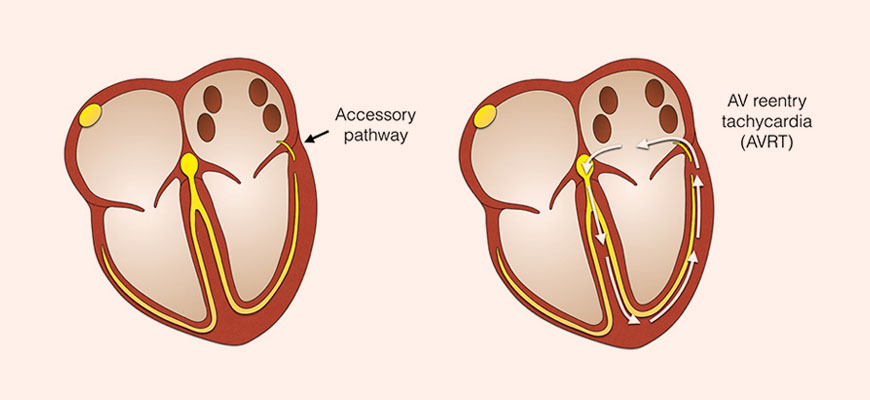
Accessory atrioventricular (AV) pathways are abnormal muscular connections that allow electrical impulses to travel directly between the atria and ventricles, bypassing the normal AV node-His-Purkinje conduction system. This results in ventricular preexcitation, often seen in Wolff-Parkinson-White (WPW) syndrome, and can lead to episodes of supraventricular tachycardia (SVT) and, in rare cases, life-threatening arrhythmias.

Embryological Basis

During early cardiac development, a ring of muscular tissue surrounds the atrioventricular canal. Normally, this tissue regresses, leaving only the AV node as the conduction bridge. However, if segments of this tissue persist, accessory pathways remain, forming abnormal atrioventricular conduction channels.

Clinical Presentation

Patients may present with:

  • Palpitations and rapid heartbeats
  • Syncope or dizziness
  • Chest discomfort
  • Preexcitation patterns on ECG (short PR interval + delta wave)

Some accessory pathways become clinically significant only during atrial fibrillation, where rapid conduction can trigger ventricular tachycardia or cardiac arrest.

Types and Locations of Accessory Pathways

Accessory pathways can be categorized based on their anatomical insertion:

Location Description Clinical Note
Left Free Wall Most common Usually accessible via transseptal or retrograde aortic approach
Right Free Wall Less common Mapping may be more complex
Posteroseptal Near coronary sinus May require coronary venous or epicardial access
Anteroseptal Near His bundle High risk of AV block during ablation

Diagnosis

Diagnosis includes:

  • 12-lead ECG to identify preexcitation patterns
  • Electrophysiology Study (EPS) to locate the pathway
  • Holter monitoring for intermittent SVT
  • Cardiac imaging if structural abnormalities are suspected

Treatment: Radiofrequency Catheter Ablation

Radiofrequency current is delivered through an ablation catheter to eliminate the accessory pathway. It has largely replaced surgical approaches due to:

  • High success rate (≈ 95–99%)
  • Low recurrence rate (≈ 5–10%)
  • Reduced morbidity

Ablation may be performed:

  1. Endocardially via femoral or subclavian venous access
  2. Epicardially using a subxiphoid percutaneous approach when pathways are deep or inaccessible
  3. Via Coronary Sinus Tributaries for posteroseptal pathways

Epicardial Ablation Insights

Epicardial mapping is considered when:

  • Multiple previous ablations have failed
  • The pathway is located adjacent to coronary sinus musculature or diverticula
  • Standard endocardial access is not feasible

In clinical studies:

  • Success Rate: ~30% as standalone treatment
  • Epicardial mapping helps guide repeat endocardial ablation in additional cases

Major complications are rare, but may include:

  • Pericarditis
  • Coronary sinus injury
  • Tamponade (very rare with experienced operators)

Post-Ablation Care

  • Observation for arrhythmia recurrence for 24–48 hours
  • Anticoagulation if ablated near left-sided structures
  • Repeat electrophysiology testing at 2–3 months if symptoms recur

Conclusion

Accessory atrioventricular pathways are a well-recognized cause of preexcitation arrhythmias such as WPW syndrome. Radiofrequency catheter ablation remains the gold-standard treatment with high cure rates and minimal complications. In difficult cases, epicardial or coronary venous approaches provide effective alternatives.

Early diagnosis and tailored ablation strategy are key to preventing long-term arrhythmia complications.

For Detailed Guides and Health Articles Visit: https://healthcaretipshub.com/

Share Article

Follow Me Written By

Healthcaretipshub

Other Articles

Agammaglobulinemia: Symptoms, Causes, Diagnosis, Treatment, and Living With This Rare Immune Disorder - Health Care Tips Hub
Previous

Agammaglobulinemia – Symptoms, Causes, Diagnosis & Treatment
Accutane Embryopathy (Fetal Retinoid Syndrome): Causes, Symptoms, and Treatment
Next

Accutane Embryopathy (Fetal Retinoid Syndrome): Causes, Symptoms, and Treatment

Next
Accutane Embryopathy (Fetal Retinoid Syndrome): Causes, Symptoms, and Treatment
February 15, 2018

Accutane Embryopathy (Fetal Retinoid Syndrome): Causes, Symptoms, and Treatment

Previous
February 15, 2018

Agammaglobulinemia – Symptoms, Causes, Diagnosis & Treatment

Agammaglobulinemia: Symptoms, Causes, Diagnosis, Treatment, and Living With This Rare Immune Disorder - Health Care Tips Hub

No Comment! Be the first one.

Leave a Reply Cancel reply

Your email address will not be published. Required fields are marked *

Search

Recent Posts

What Is Agnosia - Symptoms, Causes, Types, Diagnosis & Treatment - Health Care Tips Hub
What Is Agnosia – Symptoms, Causes, Types, Diagnosis & Treatment
Healthcaretipshub
About Drug Addiction Recovery Treatment Types, Process, and Long-Term Recovery
About Drug Addiction Recovery Treatment: Types, Process, and Long-Term Recovery
Healthcaretipshub
Essential Ways To Prevent Erectile Dysfunction Naturally - Health Care Tips Hub
Essential Ways To Prevent Erectile Dysfunction Naturally
Healthcaretipshub
Fitness and Muscle Health-healthcaretipshub
Ultimate Guide to Fitness and Muscle Health: Build Strength and Stay Active
Healthcaretipshub
10 Powerful Home Remedies to Brighten Your Skin Naturally
Healthcaretipshub

Subscribe to our newsletter and stay updated.

Health Care Tips Hub

Welcome to Health Care Tips Hub. Making accurate health information available excites us at Health Care Tips Hub. We aim to equip people and families with useful advice and doable knowledge to help them sustain a better, happier life.

© 2025 Health Care Tips Hub.
All Rights Reserved.

Quick Links

  • Contact
  • About
  • Disclaimer
  • Privacy Policy
  • Advertising Policy
  • Careers
  • Advertise with us

Category

  • Ayurvedic
  • Women’s Health
  • Men’s Health
  • Holistic Remedies
  • Fitness & Exercise
  • Nutrition & Diet
  • Homeopathic

Follow Us

Facebook
Twitter
Instagram
Linkedin
Pinterest
Youtube
  • Home
  • Health
  • Top Categories
    • General Health & Wellness
    • Nutrition & Diet
    • Fitness & Exercise
    • Mental Health
    • Disease
    • Women’s Health
    • Men’s Health
    • Pregnancy & Parenting
    • Natural & Holistic Remedies
    • Dental & Oral Health
    • Global Health Trends
    • Health Tech
    • Medicine & Drugs